Two Science-Backed Study Methods Walk Into a Classroom — Only One Walks Out the Winner
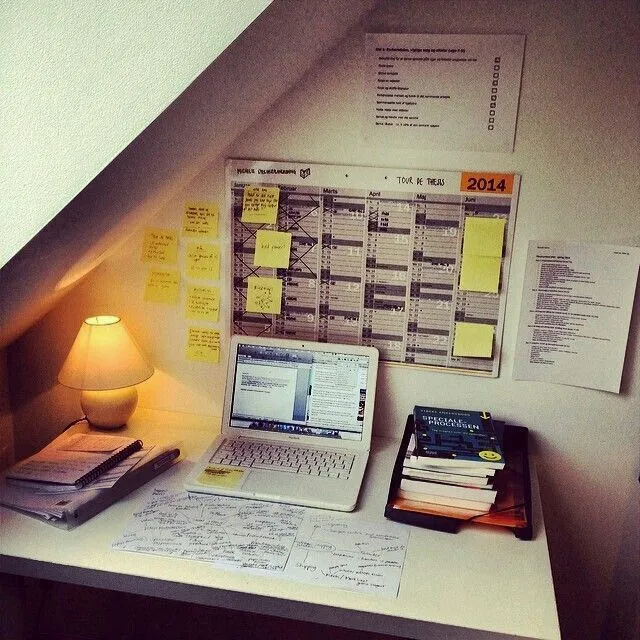
Photo: student studying with flashcards and calendar schedule on desk, via i.pinimg.com
The Setup: Two Champions, One Brain
Imagine you've got two coaches both promising to get you to the championship. One says, "Take breaks. Space it out. Let your brain breathe." The other says, "Test yourself constantly. Struggle through the recall. Make it hurt a little." Both have the research receipts to back themselves up. So who do you listen to?
This is the actual tension sitting at the heart of modern study science — the Spacing Effect versus the Testing Effect. Both are legit. Both are powerful. And if you're not using them strategically, you're probably leaving serious grade points on the table.
Let's break this down without the academic jargon, because you've got exams to pass, not dissertations to write.
What the Spacing Effect Actually Is (Not What You Think)
Most students hear "spacing" and think it just means "don't cram." That's part of it, but the real mechanism is more interesting.
When you revisit material after a delay — even a short one — your brain has to work slightly harder to pull it back up. That effort, frustrating as it feels, is doing construction work on your memory. Every time you retrieve something after a gap, the neural pathway gets reinforced. It's like paving a dirt road a little more each time a truck drives over it.
Researchers call the sweet spot the desirable difficulty zone. Too short a gap and the material is still sitting in your short-term memory — easy to recall, but not getting deeper. Too long a gap and you've forgotten so much that you're basically starting from scratch. The magic is in the middle.
For most academic content — history dates, biology vocab, legal definitions — a spacing schedule that revisits material at 1 day, 3 days, 1 week, and 2 weeks tends to outperform massed study by a wide margin in long-term retention tests.
Where spacing dominates: Factual content, vocabulary, formulas, and anything you need to retain for months rather than days. Think SAT prep, AP exams, the MCAT, bar prep — any high-stakes test with a long runway.
The Testing Effect: When Retrieval Beats Re-Reading Every Time
The Testing Effect — sometimes called retrieval practice — operates on a different principle. Instead of spacing when you study, it focuses on how you study. Specifically, it argues that the act of pulling information out of your memory is more valuable than putting it back in.
In a now-famous Purdue University study, students who read a passage once and then tested themselves remembered significantly more a week later than students who read the same passage four times. Four times versus once — and the single-read-plus-test group still won.
Why? Because every retrieval attempt forces your brain to reconstruct the memory, not just recognize it. Recognition is passive. Reconstruction is active. Active learning builds stronger, more durable memory traces.
This is why flashcards, practice tests, and the "close the book and write everything you remember" trick actually work. They're not review — they're exercise.
Where the Testing Effect dominates: Complex concepts that need to be applied, not just recognized. Math problem types, essay arguments, case study analysis, coding logic — anything where you need to do something with the knowledge under pressure.
So Where's the Contradiction?
Here's where students get tripped up. The Spacing Effect implies you should let time pass before revisiting material. The Testing Effect implies you should test yourself immediately and often. If you space too much, you lose the frequency that retrieval practice needs. If you test too often without gaps, you're not getting the spacing benefit.
They seem to push against each other — but only if you treat them as separate strategies competing for the same time slot.
The Trick: They're Not Competing. They're Sequencing.
Here's the GK Tricks take on this: spacing and testing aren't rivals. They're a one-two combo, and the order matters.
Think of it like this:
Phase 1 — Initial Encoding: You learn the material once, actively. Read it, watch it, whatever your input method is. Don't re-read it immediately.
Phase 2 — Early Retrieval (Testing Effect kicks in): Within 24 hours, close everything and test yourself hard. Flashcards, practice questions, blank-page recall. This is where the Testing Effect does its heavy lifting — the memory is fresh enough to retrieve but you're still reinforcing the pathway.
Phase 3 — Spaced Returns (Spacing Effect takes over): Now you let time pass. Come back at day 3, day 7, day 14. Each return session? Also done as a test, not a re-read. You're now layering both effects on top of each other.
The result is a compounding advantage. Each spaced session is also a retrieval session. You get the depth from spacing and the strength from testing — simultaneously.
Practical Application for Real Exam Prep
Let's say you're studying for the US History AP exam and you've got six weeks.
- Week 1: Learn a new unit. Test yourself on it the next day using practice questions or a brain dump.
- Week 2: Return to Week 1 material with a short quiz before adding new content.
- Week 4: Hit Week 1 again — this time with harder application questions, not just definitions.
- Week 6: One final pass on everything, prioritizing the stuff you got wrong in previous rounds.
This isn't rocket science, but it's also not how most students study. Most students re-read their notes the night before and wonder why nothing sticks.
The Honest Answer to "Which One Wins?"
Neither one wins alone. Spacing without testing is just delayed re-reading. Testing without spacing burns out your working memory and doesn't give retention time to consolidate. The research backs both — and the research also shows they amplify each other when combined.
If you had to pick one in a pinch? For long-term retention on fact-heavy material, lean spacing. For skill-based or application-heavy content in the short term, lean testing. But honestly, if you're only using one, you're only getting half the upgrade.
The students who consistently outperform their peers on competitive exams aren't necessarily studying more hours. They're engineering their study sessions so that every hour does double duty. Spacing plus retrieval is exactly how you get there.
Now close this article and see if you can recall the main points. Seriously — that's not a joke. That's the Testing Effect, and it starts right now.